

Well, here we are. Finally back in the Netherlands. Furlough at last. Enjoying all the luxury and do things that are otherwise impossible. Going to the theater; cinema; visiting family and friends; giving presentations and sermons; to the swimmingpool; museums and so on. But no, instead of nice and relax conversations, we are mainly talking about the miserable pandemic caused by Covit-19 (SARS-CoV-2) or the Corona virus. A virus from a family which was not unknown, but in the past was only limited to the Asian regions.
How we feel? That is a regularly asked question. Well, disappointed of course! Sad too. Both Katja’s parents and mine (Jurgen) all are close to their 80s and are at risk because of their health. At the time of writing, they are doing well and we are grateful for that. But what a sad situation for so many others.
We, as a missionary family, are not unknown to the life style we have now. We live fairly isolated in Maroamboka and are therefore somewhat used to it. Homeschooling? Not new to us. Not just going to the supermarket for a small thing? Not strange either. Sitting in the house for days? This is the rule during the rainy season. No toilet paper? … We don’t even have that in Maroamboka.
But for many fellow Dutch nationals. A sense of panic, powerlessness and disillusionment. In Holland we were no longer used to this kind of life. Now what? Everything that was so common is no longer possible. Writing and reading messages on your smartphone all day long is getting boring as well. What if I get the virus too?
Nevertheless, we consider ourselves lucky that we are in the Netherlands at this moment. Things are well organised here. Health care is given top priority. The social safety net for victims can take many blows. If one gets sick, one can get the care one needs. We can also just go shopping and, if everyone behaves normally, there will be enough. Our Prime minister Rutte said: “There is enough [toilet paper], we can [all] poop for ten more years”. In otherwords: Behave!
Of course we follow the situation on Madagascar with sorrow and concern in our hearts. How different it is there! Social distance? Wow, have you ever been to the market in a random town. Or have you ever seen how people live? Most homes in large cities are not affordable, so the whole family lives in one room. There, in that room, they can sleep and shelter during the rain, but locked up together all day brings greater dangers than Corona. Everything and everybody is social in Madagascar. It is unfair to say that they should stop doing that for a while. That would be like banning private internet use in Europe or any other strong economy country for that matter. Let that idea sink in for a while.
Last night we read the press release from President Rajoelina. Many people think of him as a big crook. But now it seems that this crook takes Corona very seriously. 12 infected people are now known and all have been isolated. Unprecedented measures have been taken. The capital, Antananarivo, and the large port, Tamatave, are completely locked down. No public transport; health checkpoints; all small shops and markets closed; people are only allowed to shop in their own neighborhood (1 person per household); forbidden to go outside between 20:00 and 05:00; food prices have been frozen under penalty of a fine. President Rajoelina addresses the people every night. At 20:00 on the national channel, the Malagasy can stay informed about the current situation. Madagascar is no stranger to epidemics. Epidemics such as, the almost annual, outbreaks of the plague. Let’s pray that the government can also curb this epidemic.
Our heart goes out to the Malagasy. Because of the (often) bad conditions in which people live, even young people are vunerable. They look strong. They carry 50kg of rice on their shoulders. But one-sided nutrition and unhygienic homes plagued by rats and parasites are a recipe for a weak immune system. In addition, many Malagasy are simply terrified and have a very fatalistic attitude. Too often we hear it said by our Malagasy friends: “Well, that’s the way it is. The Malagasy just die quickly.” How it hurts us when they speak like that. How we would like to see them standing tall in life. That they would realise how much they can do to change their ‘fate’ themselves. And above all, that they would realise that the Almighty is not far away but has come to the world to save her. Saving from Corona? Saving from the plague? Possibly, but I’m more thinking about the boldness that comes with the confidence that Jesus saved you for eternity. Below, a quote from Martin Luther in a time when the plague went around Europe like a roaring lion, devouring who it could devour:
“I shall ask God mercifully to protect us. Then I shall fumigate, help purify the air, administer medicine and take it. I shall avoid places and persons where my presence is not needed in order not to become contaminated and thus perchance inflict and pollute others and so cause their death as a result of my negligence. If God should wish to take me He will surely find me and I have done what He has expected of me and so I am not responsible for either my own death or the death of others. If my neighbour needs me however I shall not avoid place or person I shall go freely as stated above. See this is such a God-fearing faith because it is neither brash nor foolhardy and does not tempt God.”
Luther’s Works; Vol. 43, pg. 132


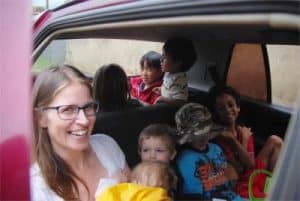 Traveling by normal car is also different. Seatbelts – if there – are hardly being used and there are no children’s car seats. The possible number of passengers is again quite flexible. Only a week ago we saw it no problem to fit 3 adults and 8 children in a car when using the back (a favourite place of our children). It is very baby-friendly: you can drink while traveling!
 Katja ordered two Dutch books. The were shipped to Madagascar. To collect the parcel she had to travel to Analakely, Tana (17km). Because all Buses were full she had to take a taxi for the first stretch. There she took a bus for the second part. With a second bus she arrived at Analakely. Ones there she had to walk up a hill to a post-office to get a stamp and a signature. With that she walked down to another post-office. There they wanted to see her passport and she had to give two signatures and after receiving another stamp and paying 2000 Ariary she received her parcel. She was able to take a bus that drove back home in one stretch. The trip to collect her parcel took her 4 hours.

 We were not alone! A total of 22 adults and 28 children joined us and they were all ready to serve the Lord at different places. To see a bigger version of the photo on the richt you can click on it. The first week at ABO we have studied the African culture and values. Among our tutors was a Kenyan man who lived in the UK for several years. This made that he could relate to our western culture as well as to the African culture. It was good to talk with other missionaries—some of who already work in Africa for several months or even years. We have learned a lot from each other.
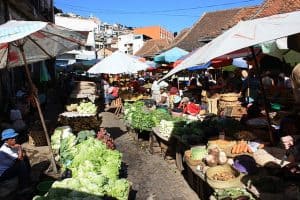 Buying food is fun. Delicious mangos for only € 0,08 and banquettes for only € 0,11. We can buy all sorts of things on the market. This week we bought 1 kilo tomatoes, 1 kilo carrots and about 400 grams of beans for 2400 Ariary (€ 0,67). Other things are more difficult to find. Full grain bread is hard to come by and can only be found in the supermarket but than you will have to be prepared to pay more.
 We love to see all the learned theory in action. At the same time we are very tired at the end of the day. This ‘end of the day’ is about 6 pm—the sun has gone under by then and will be up as early as 05:20. Thus our day starts at 6 am and around 9 pm we are already in our snug beds… talking about which…
