Abbey is our third child (2008). She is the creative one. Give her some tape, glue and paper and you’ll end up with fantastic creations.


Abbey is our third child (2008). She is the creative one. Give her some tape, glue and paper and you’ll end up with fantastic creations.

Dani (2011) is a real trooper. When we lived in the village, he loved to walk around barefoot through the rice fields and woods. He could be busy like that all day long in order to return home with a bag full of berries. Dani is also very clever with computers and often writes his own codes.

Simeon is our youngest (2015). He is the lucky one as he gets all the attention of his siblings. Simeon is a smart boy and very easy going. Without much trouble he switches between the rural and urban life and between the spoken languages.


Het is 3 januari en we genieten van de kerstvakantie. Het is lang geleden dat we als gezin Tsiombivohitra hebben bezocht en nu hebben we de tijd. Iaban’i en nendrin’i Melice, de koning van het dorp en zijn vrouw, weten dat we komen en hebben zich voorbereid: bij het vuur ligt al een gebonden kip klaar. ‘We blijven toch zeker eten?!’ Het is echt genieten bij hen: we krijgen allemaal—de kinderen ook—een kop koffie met suikerrietsap en we kletsen gezellig bij.
Tsiombivohitra is ‘ons eerste dorp’. Toen we hier in 2016 voor het eerst als gezin kwamen hebben we gevraagd of we als zendelingen bij hen welkom zouden zijn. We legden uit dat we ook vrienden nodig zouden hebben. Er volgde luid geroezemoes en daarbovenuit verklaarde nendrin’i Melice luid en duidelijk dat we vrienden zouden zijn. Ook toen al straalde ze: er was meteen een klik.
De mensen uit Tsiombivohitra hebben sindsdien veel geduld moeten hebben: na ons bezoek in september 2016 moest eerst ons huis gebouwd worden. In februari 2017 konden we erin. De eerste tijd waren we, behalve met het leren van het dialect en de plaatselijke cultuur, veel tijd kwijt met praktische probleem en leren hoe hier te leven. Het contact met Tsiombivohitra hielden we warm, maar van Bijbelverhalen vertellen kon nog geen sprake zijn, omdat de verhalen nog niet in het dialect waren vertaald. Tot ons eerste verlof in oktober 2017 was daarvoor 8 maanden de tijd.
In april 2018 waren we weer terug in ons huis in Maroamboka. Een van de eerste dingen die Jurgen oppakte was het contact met Tsiombivohitra. Vanaf mei vorig jaar ging Jurgen daar wekelijks heen om in het huis van de koning en zijn vrouw het evangelie te delen met wie maar horen wilde. Van meet af aan was met name nendrin’i Melice zeer geïnteresseerd. Haar man bevestigde de vriendschapsband door samen met Jurgen van hetzelfde bord te eten en uit dezelfde beker te drinken. Een andere keer zat de hut stampvol met dorpelingen.
Maar toen kwam eind juni: de koning en zijn vrouw waren niet thuis. In juli was er af en toe een enkeling die kwam luisteren, maar in augustus was het dorp leeg! We begrepen er niets van. Waar was iedereen? Het antwoord: naar de markt. Dat maakte het voor ons niet duidelijk. Naar de markt gaan is leuk, maar er was toch een afspraak? En Jurgen moest er 7 km heen en 7 km terug voor lopen in de brandende zon! We deelden onze frustraties met vrienden. Iedereen leek het de normaalste zaak van de wereld te vinden dat Tsiombivohitra leeg was op marktdag. Uiteindelijk werd ons duidelijk dat de markt vooral een sociale aangelegenheid is: daar moet je heen. We hebben ons dus maar bij de koffiemarkt neergelegd en het seizoen afgewacht. De koffie-oogst en de bijbehorende markt duurden nog tot eind november. Gelukkig ging het werk in andere dorpen ondertussen door.
Na 5 maanden pauze was het spannend de bezoeken aan Tsiombivohitra weer op te pakken: betekende hun keuze voor de markt desinteresse of was het puur een culturele aangelegenheid? Al snel werd duidelijk dat Jurgen—met Bijbelverhalen—nog steeds welkom was. De derde keer was het verhaal over de smalle en de brede weg aan de beurt, het moment in de verhalenreeks waarop mensen een keuze wordt voorgehouden. Nendrin’i Melice gaf daarop aan dat ze Jezus wilde volgen. Jurgen heeft toen uitgelegd dat het leven van een gelovige moeilijk is en dat het offers vraagt. Hij heeft haar aangeraden er goed over na te denken en gezegd wat ze zou kunnen bidden als ze door wilde zetten. De weken daarop heeft hij het verhaal herhaald, ook vanwege nieuwkomers.
Zo ook op 3 januari. Jurgen legt uit wat de 2 wegen zijn als nendrin’i Melice uitroept: ‘Ik ben op de smalle weg!’ Ze ziet zielsgelukkig en voegt later toe: ‘Ik ga naar de hemel!’
In een privégesprek vertelt de koning later dat hij en zijn vrouw nu geloven, maar dat het moeilijk is. Van een koning wordt veel verwacht en daar komt bij dat hij de jongste is van 2 koningen in het dorp. De oudere koning—tevens toverdokter—moet worden gerespecteerd. Ze beginnen nu al te ervaren dat geloven wandelen op een smalle weg is, maar het geluk is te lezen in hun ogen. Een mooier Kerstcadeau hadden we ons niet kunnen wensen dan die ochtend in Tsiombivohitra te zijn.

NB:. This Fundraiser has finished with a good result!
For those who do not know us: We are Jurgen and katja Hofmann and together with our five children we live in Maroamboka, Madagascar. Maroamboka is a remote rural village situated in the south-east of Madagascar in the middle of the Antanala area. The Antanala have to live and work under very harsh circumstances. They have to work hard for as little as 0,75 Euros a day. Especially after the cyclone season the area is very hard to reach by road.
It is our passion to tell the good news of Jesus Christ to those who have never heard; to give them the chance to believe and be saved. Besides sharing the Gospel we try to help people improve their circumstances. Last year we did this by repairing, together with the locals, all water pumps in and around Maroamboka. We also help people to become aware of the importance of good hygiene. Finally we hope to be of assistance in improving the overall situation in which the people need to live.
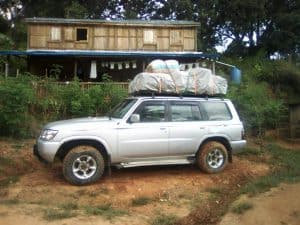 The roads are extremely bad and even though we have a sturdy 4×4 it is not always possible to come in or out of the area. After living in Maroamboka for a year we have to the conclusion that our car needs some modifications. These modifications will help us greatly to travel in and out the area more easily and, not unimportant, more safely.
These modifications are costly. Overall all modifications on 4x4s are expensive on Madagascar. This is the reason we started this Fundraising on Facebook.
We truly hope that we can raise enough money this way. It will help the Antanala people greatly!

On the 11th of February we are organising a meeting in which we will give a presentation of our work on Madagascar. No worries, we fully understand that you might have others things to do than travelling up to Holland for this occasion.
However, there is one thing you can do to get a glimpse of our lives on
Madagascar! You can watch the tour in and around our house given by Katja and the children. In an 18 minutes video they will show you every corner of our house and there playground.
For now we give you a little teaser but stay tuned as on the 11th of February this video will go live!
TRAILER: A Tour In And Around Our House in Maroamboka

August 2017
It was Friday the 9th of June in the afternoon that we said to each other: ‘What a relief that we could bring Anna (a visiting co-worker) to the bus station this morning. Surely we cannot leave the area any time soon after all this rain. Let’s hope nothing happens.’ That night Jurgen woke up with a terrible pain in his stomach and back. When he also started to show symptoms of bowel obstruction we were truly alarmed and decided to ask for an evacuation. At the beginning of the afternoon on Saturday a helicopter took Jurgen to a hospital in the capital.
Half a week later Jurgen was released from hospital after minor surgery. A large kidney stone was removed from his urinary tract and later that week he passed a smaller one naturally. A friend took him in and, after regaining some strength, Jurgen came back home after two weeks. We were all still very impressed with what had happened, but a week or two later Jurgen was his usual self again: ready for work!
However, for the translation of the Bible stories, Jurgen is dependent on Menja, the local school teacher. He speaks both official Malagasy and the Tanala dialect. He translates the stories from Malagasy to Tanala, after which Jurgen and he go through each and every story in detail checking the content against the Bible and making sure the stories are easy to understand. When Jurgen was well again Menja was very busy finishing the school year, and after that he became ill for weeks.
Halfway through July we had only one week left before having to return to the capital for supplies and paperwork. We were somewhat discouraged and felt we had accomplished little. We noticed that our friend Menja, although recovered from sickness, also seemed gloomy. He told us he was not able to visit his family for lack of money as he had not been payed his wages for seven months!
We suggested Menja we would pay him for every Bible story he translated. He did not agree: he liked helping and between friends no wages should be payed. ‘How would you feel about a gift for every story you complete?’ we asked. His face broke into a smile. We soon agreed on the size of the gift and half a week later he had completed the whole first set: we now have 40 stories to work on! Unexpectedly we left our village quite content, and Menja was able to leave the next day to visit his parents.